World-First PRP / PTP Tester
at the ISPCS 2025 Plugfest

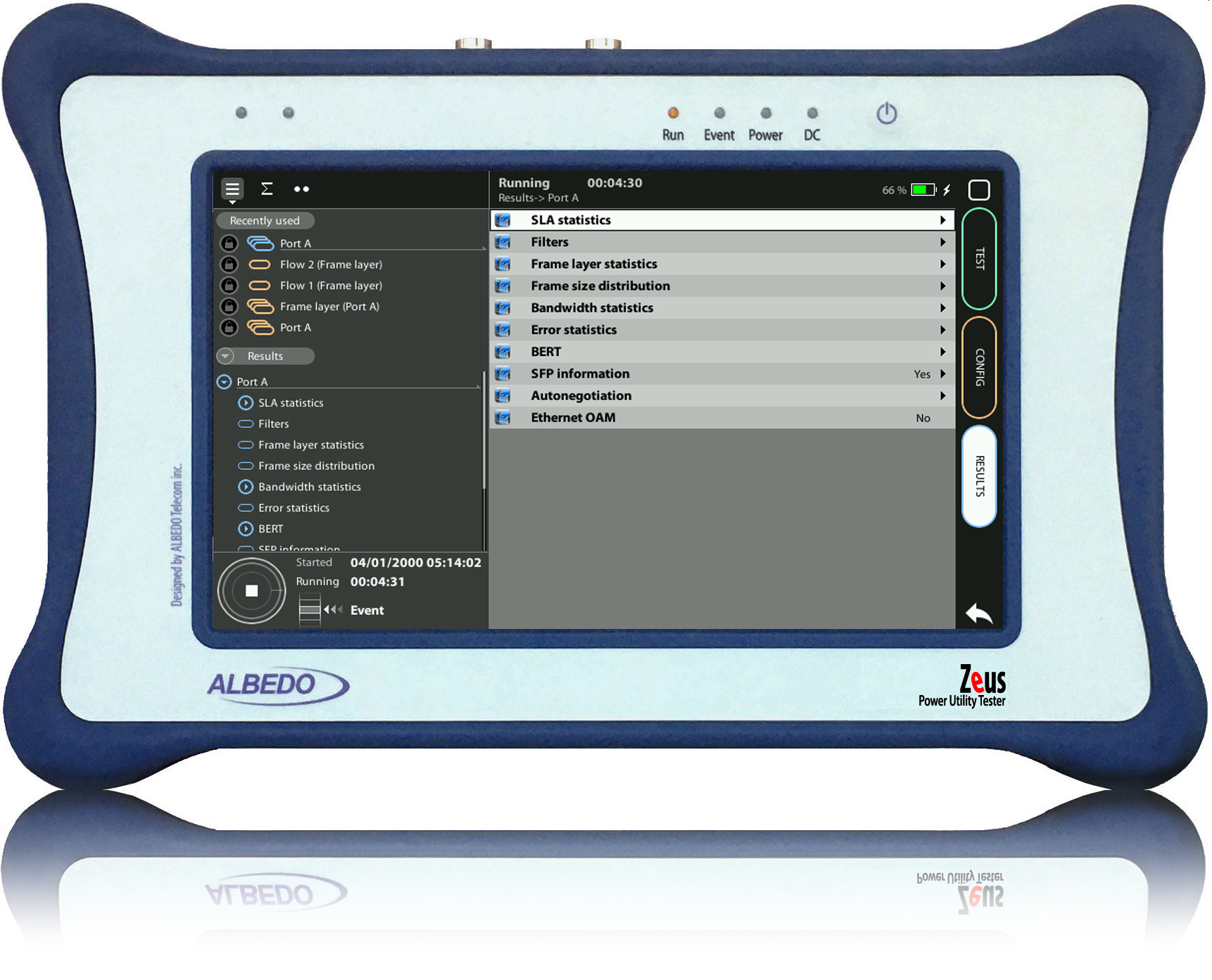

PRP, PTP, NTP, GOOSE, SV, MMS protocols capture and analysis

Supports legacy (IRIG-B, T1, E1, PPS...) to assure IEC-61850 migration

PTP wander analysis and generation

Full C37.94 analysis + emulation

Hot-swappable modules


A tester for the new digital grid
Zeus is a tester designed to install and maintain the communications in the power industry. It supports legacy and new generation interfaces in order to verify Ethernet / IP, PTP, SyncE, ToD, IRIG-B, T1 / E1, C37.94, RS-232, G703 and protocols such as GOOSE, SV or MMS, therefore you will get a perfect vision and control of your infrastructures improving protection and data acquisition.

In substation automation many resources require accurate synchronization ranging from microseconds to milliseconds:
- Applications that use SV / GOOSE /PRP eed to minimize latency.
- Data acquisition at IED, RTU and MU.
- SCADA and the MMS protocol.
- Line protection schemes.
- Events recording.
- Synchro-phasors deployed across the WAN to monitor the power grid.
Zeus has a complete set of features for time commissioning by means of measurements, analysis and protocol emulations of PTP, IRIG-B, GPS, SyncE, T1/E1, 1PPS
Platform
Multiport Interfaces
A:B ports: 2 x SFP (100MbE, 1GbE)
A:B ports: 2 x RJ45 (10MbE, 100MbE, 1GbE)
C:D ports: Balanced 2 x RJ45 (T1/E1)
C:D ports: Unbalanced 2 x BNC (T1/E1)
GNSS Port: SMA female (GNSS)
PPS Ports: 3 x SMB female (Time refs.)
Hot swappable modules
C37.94
Datacom DTE/DCE: V.11/X.24, V.24/V.28, V.24/V.35, V.24/V.11 (V.36/RS449)
VF Port
Codirectional - G703
E1/T1
Optical to Electrical
Operation / Results
Graphic and tabular wander results
Navigation: by touch screen, keyboard, mouse
Remote Control: by VNC
Storage capacity: one week of results
Export: results in pdf/txt/csv through USB interface or SD card
Report export to remote host through Ethernet / IP
Ergonomics
Size: 260 x 160 x 63 mm
Weight: 1.9 kg
Light and easy to carry in a small bag
Start: Manual / Timed with optional password
Batteries
Two pack of Lipo batteries always included
Large duration that also depends on operation, conditions, aging, etc.
Time / Clocks
Internal Clocks
Default better than ±2.0 ppm
OCXO better than ±50 ppb
Rubidium better than ±5.0e-11 (GNSS disciplined, locking time < 4 hours)
Internal Rubidium clock
Free―run (No GPS)
Freq. accuracy (7.5 minutes warm up): ± e-9
Freq. accuracy on shipment (24 h. warm up): ±5.0e-11
Aging (1 day): 2.5e-11
Aging (1 year): 6.0e-10
GNSS locked
Phase error (RMS), single-band GNSS: ±15 ns
Phase error (RMS), multi-band GNSS: ±5 ns
Hold - over
Phase within ±100 ns: 10 hours
Phase within ±500 ns: 30 hours
Phase within ±1.0 μs: 60 hours
Phase within ±10.0 μs: 12 days
Clock References
Built-in GNSS receiver
SyncE
IRIG-B
T1/E1
10 MHz
5 MHz
2048 kHz
1544 kHz
1PPS
1PP2S
ToD
IEC-61850 testing
PRP testing
Emulates one or multiple PRP endpoints, supporting both Dually Attached Nodes (DANs) and Singly Attached Nodes (SANs).
Generates and receives multi-stream traffic in PRP environments
Performance metrics such as delay, frame loss, and throughput
PRP statistics, PRP node detection, redundancy checks, frame counters
Generation and analysis of delay skew between LAN A and LAN B traffic
Capture, Event Logger to decode and report PRP-specific fields and frames
Enables protocol testing over PRP, for SV, GOOSE, and PTP
PTP over PRP master/slave emulation, TE on LAN A/B, Ports skew
GOOSE testing
Decodes and analyzes GOOSE messages
GOOSE protocol scan with GoCBName, GoID, DatSet
GOOSE frame count for the active flow and all flows
Latency: current, avrg., min., max., range and std. dev.
SV testing
Decodes and analyzes SV messages
SV protocol scan with svID population
SV frame count for the active flow and all flows
Sample count and sampling rate measurement
Latency: current, avrg., min., max., range and std. dev.
PTP testing
PTP profiles: Telecom and Power
Encapsulations: Ethernet and UDP
Clock emulation: Master / Slave, Unicast/Multicast, 128 packet/s
PDV capture, protocol analysis and correction field support
Ethernet PTP Frequency testing
Floor Delay Population (G.8260): FPC, FPR, FPP
Wander: Analysis and Generation TIE, MTIE and TDEV (in real time)
Ethernet PTP Phase testing
Measured at GbE and 1pps interfaces
Time Error (TE): Maximum (max |TE|), Dynamic (dTE), Constant (cTE)
1 pps testing
Wander: TIE, MTIE, TDEV
Time Error (TE): Maximum (max |TE|)
C37.94 testing
Operation Modes
Unframed or framed operation
Clock: Recovered or Internal
End point or terminal mode
Results with PASS/FAIL indications
Analysis & Generation
Bit Rate generation in steps of nx64 kb/s up to 768 kb/s
BER test
ITU-T G.821 performance test
Event Detection / Insertion
Defects: LOS, AIS, LOF, RDI, LSS, All 0, All 1
Anomalies: FAS, TSE, Slip
Delay & Freq. Tests
Round Trip Delay (ms)
One-way Delay synchronized with GPS
Frequency (Hz)
Frequency Deviation (ppm), max. Deviation
Jitter and Wander analysis
Peak to peak, RMS, jitter, hits detection and count
MTIE and TDEV resolution: 100 ps
Pass / Fail based on standard masks
C37.94 SFPs
Multi-mode: SFP 850 nm, 2048 kbit/s, 1500 meters
Single-mode; SFP 1310 nm, 2048 kbit/s, 10 km
Optical Power Meter
Latency & Delay measurements
E1, T1, GbE, C37.94
Round-trip delay (RTD)
One-way delay (OWD) GNSS assisted
Ethernet PTP
Floor delay packet population, ratio/percentage/count
Path delay asymmetry
End-to-end / peer-to-peer path delay mechanisms
Master-to-slave / Slave-to-grandmaster latency
PTP packet delay variation test
Time Error (TE): Maximum (max |TE|), Dynamic (dTE), Constant (cTE)
Service Disruption Time
Interfaces: E1, T1, IEEE C37.94, Datacom, Co/Contra-directional
Resolution: 100 us
Ethernet/IP Testing
8 x independent streams
Streams: may use individual sour/dest. addresses and bandwidth profile
Internet Protocol: IPv4 / IPv6 support
Frames: DIX, VLAN, Q-in-Q, CoS (DSCP/PCP), MPLS, and Jumbo
IP with UDP or arbitrary protocol
DHCP for source IP and ARP for destination MAC
Counts et statistics
Frame counts, IP traffic statistics, and bit rate
Top ten VLAN, MAC, IPv4 and IPv6 addresses
QoS: Latency, Delay variation, Loss ratio, SES, Availability, OOS, Duplicated
BER Tests et Patterns
Traffic generation: Continuous, Burst, Ramp, Random
PHY layer: RPAT, JPAT, SPAT, HFPAT, LFPAT, MFPAT, LCRPAT, SCRPAT
Layer 2/4 PRBS: 2e11-1, 2e15-1, 2e20-1, 2e23-1, 2e31-1
Layer 2/4 PRBS: all inverted versions
Symmetric/Asymmetric RFC-2544
Throughput
Latency
Loss
Back-to-back
System Recovery
Symmetric/Asymmetric eSAM (Y.1564)
Latency, Delay Variation, Loss, and Availability
Eight / four services (colour/not colour)
CIR, EIR, max, Througput
Loopback
L1 - L4 loopback mode
Traffic filtering by
sour/dest MAC/IP/Port
VLAN, CoS (DSCP/PCP)
Protocol

PDH / T.Carrier testing
Interfaces
T1 (ANSI T1.102)
E1 (ITU-T G.703)
E0/Co-Directional (ITU-T G.703)
Modes
Terminal
Monitor
High Impedance
Pass-through
T1: Framed SF and ESF and unframed Generation/Analysis
E1: Framed PCM-30 / 31 with/without CRC and Unframed signals
T1/E1: Display and Edition: all fields, CAS, Pulse Masks, Events
Channel map: Busy/Free, External Drop/Insert of 64 kb/s co-dir or datacom
Measurements
BER
Line/Freq
Errors/Alarms
G.821, G.826, M.2100
VF: tone generation/analysis
Attenuation, Freq, Freq. deviation, Level, Peak codes
Synchronization
Jitter analysis: Peak to peak, RMS, hits, count (0.1 to 100 kHz range)
Wander: Analysis/Generation and masks (1 μHz to 10 Hz range)
Wander Analysis/Generation in 10 MHz, 2048 kHz, 1544 kHz, 1pps
Cable features
Cable tests
Wiremap
Skew
Cable Diagnostics
Distance to fault
Power over Ethernet
PoE and PoE+
Volts / Current
Datacom testing
Modes
Terminal emulation
Bi-directional Monitoring
Datacom / E1 mux
Display and Edition
DTE/DCE control circuit
Timing circuits
Binary rates
Tests
BER, Frequency
Insertion/Analysis of events
G.821